

Alliums
Babington Leek. This perennial is located botanically somewhere between our usual leeks and garlic. It is most similar to elephant garlic. It can be used like a normal leek. But the bulbs are similar to garlic. If the leek is not harvested a flower will develop, no viable seeds but fleshy top bulbils develop after flowering. If the bulb is dug up, there are small bulblets hanging off the main bulb.
You can use Babington leek like real leek the slight garlic tang of the leaves disappears when cooked, or use the bulbs (harvest them after the plant has flowered) like garlic or like onion/shallots, use the young top bulbils (which don’t have a hard skin yet) in the garlic crusher like you would a peeled garlic clove. All parts of Babington leek are useable and the garlic flavour is slight. The plants go dormant in late summer and resprout again late autumn. Best to mark the spot where they were planted. In early autumn, after flowering, I use the bulbils and dig up the bulb. The bulb has a few large cloves. There are smaller bulblets hanging off the bulb. These vary in number, they are encased with a light brown, hard skin with a sharp point. Leave these and they will eventually grow a new Babington leek. Elephant garlic has similar bulblets, which can be used to grow more elephant garlics, but Elephant garlic does not produce top bulbils. The bulblets sometimes take two years to sprout. I took some bulblets out last year and put them in a pot. Only one has sprouted, the others are biding their time. The top bulbils sprout much quicker.
Babington leek is a permanent plant and not part of crop rotation, they need their dedicated spot in the garden. I tried to rotate my Babington leeks and ended up with 3 locations in the garden where they come up as they like. Even if you think they have all been dug up, it is very likely that they will sprout up again in future years, either from bulbs left in the ground or from bulblets. Any top bulbils left will also sprout and grow into plants, a bit like walking onions.
I have packed seed bulbils for the circle. They need a bit of help initially to prevent them drying out. Please plant into pots in a sheltered place initially where they will sprout quickly, then plant outdoors in spring. Babington leek grows slower than normal leeks. It will take a year to grow into a sizeable leek, two to flower and produce a good bulb with several large cloves. From then on, they will always spring up again. Once established, they thrive on neglect. Galina
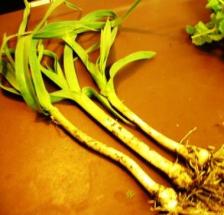
Above : Mature leeks (sorry bad photo, they are much greener) by Galina.

Above : Babington Leek flowering and developing bulbils by Galina.
Elephant Garlic Produces large mild flavoured bulbs. Penedesenca

Above: Elephant Garlic Clove v Normal Garlic Clove by Penedesenca
Broad Beans (Vicia Faba)
Black Russian. A black broad bean that looks nice and tastes nice. Ruud
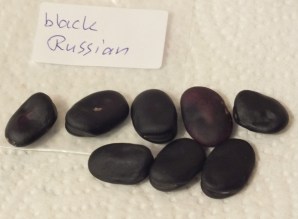
Above: Black Russian Broad Bean. Photo provided by Penedesenca
Climbing French Beans (Phaseolus vulgaris)
Buxton Buckshot. An old variety that was grown around Buxton in Maine, US. The beans are small, round and birds’ egg speckled. They’re good for drying especially. It’s semi-climbing growing to about 4ft and benefiting from some support. JanG
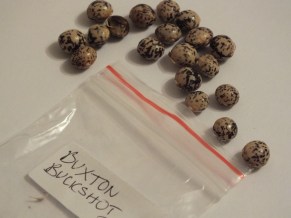
Above: Buxton Buckshot Bean. Photo provided by Penedesenca
Crochu de Savoie A yellow “shrimp” (curved) type Climbing French Bean from France (my donor was Jannes Aalders from the Netherlands) which is good to eat as “green bean”. The short yellow curved pods are delicious and look pretty on the plate too. This one produces after the summer holidays, when the early beans are no longer so productive. These beans can be eaten young but also quite late when the seeds inside the pods have already developed. I think they are nicer that way. Galina
http://www.bohnen-atlas.de/sorten/c/607-crochu-de-savoie-gruene-bohne-
Garden of Eden A pole bean who can be used as a young green or as a dry bean. Ruud

Above: Garden of Eden Bean. Photo provided by Penedesenca
George’s I got these from HSL and here is their description. “Thought to have originated in Poland, this variety produces creamish-white flowers and attractive pods that, when mature, are green flushed with red. Use fresh as a succulent, stringless green bean, ideal for salads. Alternatively, the half white and half red, sometimes mottled, dried beans make an attractive addition to soups and stews.” Galina
https://www.gardenorganic.org.uk/sites/www.gardenorganic.org.uk/files/hsl_catalogue_2015.pdf
Hidatsa Shield Figure A fairly productive climbing bean originally from Heritage Seed Library. It can be eaten fresh when very young, grown on for shelling or saved for very attractive dry beans. From the Hidatsa tribe who raised corn, squash, beans, and sunflowers in the Missouri River Valley of North Dakota. Shield Figure beans are described in the book, Buffalo Bird Woman’s Garden. The seed coat pattern is said to resemble a warrior bearing a golden shield. JanG
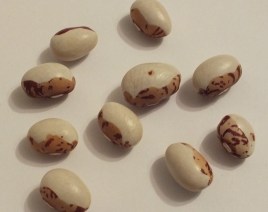
Above: Hidatsa Shield Figure Bean. Photo provided by Penedesenca
Lazy Housewife We had the white seeded Lazy Housewife in the circle before and this is the brown seeded one from Heritage Seed Library with the same name, also CFB. Dual use for eating fresh and for dried beans. These are coming into their own as second earlies, to borrow a potato descriptor. Very useful for harvesting from late August onwards. The pods are very long and curved. Does not need many to fill a saucepan. I am afraid that I have not taken photos, here is the HSL description. The beans are green not as yellow as is appears on their photo: https://hsl.gardenorganic.org.uk/seedlist/french-bean/lazy-housewife Galina
Tamila A climbing bean, productive but not too rampant. Attractive roundish pink/red mottled beans.Another one from Russell Crow.He says, ‘Oval 5 inch (12cm) pods contain between 5 to 7 seeds. The variety is grown in western Ukraine. My seed comes from a New York state “Seed Savers Exchange” member.’ Heritage Seed Library also carries this bean and gives more background: Named after our donor’s best friend this variety originates in the village of Kostilnyky, western Ukraine, an area where traditional crops continue to be grown on a large scale. The plants do show some variability, with some determined to climb, a normal characteristic of this type of local variety. Produces a heavy crop of pretty pink beans, best used for drying. – HSL. JanG

Above: Tamila Bean. Photo provided by Penedesenca
Trout bean (or Forellenbohnen). A climbing bean, vigorous and prolific; very good as a dried or shelled bean. Originally from Beans and Herbs. Apparently a newish Austrian variety, also appearing as Cranberry Lilac, Forellenbohnen (Trout bean), Forelle fliederfarben (Lilac trout) or Cranberry Flieder. So quite some confusion over names. JanG

Above: Cranberry Flieder Bean. Photo provided by Penedesenca
Dwarf French Beans
Cyrus gray A dwarf bean used as a green bean,snap bean. Ruud
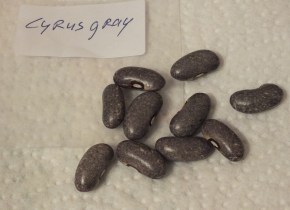
Above: Cyrus Gray Bean. Photo provided by Penedesenca
Ice Crystal Wax (Semi Climbing) – Description from HSL Catalogue: Dating back to at least 1882, this Dutch-bred variety was used by the English as a forcing bean in hothouses (William Woys Weaver, 1997). Produces compact plants with white flowers followed by green pods that lighten with age to almost a silver-white with a mauve tinge. With a little imagination these give the impression of icicles. Good flavour and texture when cooked after freezing. Also dries well for use as a pulse. Earlypea
Idelight. A dwarf bean bred by a University of Idaho plant breeder and released to the public in 1951, and re-released in 2014 to celebrate the university’s 125th anniversary. My seed came from HSL originally. HSL reckon it’s also appears as Gourmet’s Delight, which is fairly commonly available.It’s good as a green bean and is almost stringless. JanG
Smith River Super Speckle. A dwarf, productive, very attractive bean. From Russell Crow in US (see https://www.abeancollectorswindow.com). It was originally an outcross in the early 1980s from Jacob’s Cattle but is now very stable. JanG

Above: Smith River Super Speckle Bean. Photo provided by Penedesenca
Brassica
Taunton Deane Kale A hardy perennial kale that when mature has a height and spread up to a metre. I got this some 5-6 years ago from Knightshayes National Trust. I find this variety sweeter than Daubentons. In cooler months it can develop a purple tinge. This variety does not produce seed so can only be propagated vegetatively. It is quite simple, push cuttings in to a pot of compost, leave for 1-2 months in a sheltered spot and then they should be ready to grow own. I have taken cuttings all year round with success. Penedesenca
Fruit
Brown Turkey Fig Specially selected for the UK climate, Fig ‘Brown Turkey’ is fully hardy and can be grown very successfully outdoors. This popular self fertile fig tree produces large crops of sweet, juicy figs with a deep red flesh under their brown skins. With their attractive lobed foliage, Figs make a dramatic feature when fan trained against a sunny wall or grown in a container on the patio. Fruits develop in spring and ripen from August to September. A second crop often develops in late summer and if protected, these fruits will ripen during the following summer. Height: 3m (9′). Spread: 4m (13′). (description taken from Thompson and Morgan). Fig trees can be grafted, however I just root cuttings by pushing cuttings in to a pot of compost, leave for 1-2 months in a sheltered spot. Penedesenca
Japanese Wineberry
Grains
Caffrey’s Oats. Originally from Brown Envelope Seeds. BES’s say ‘ Avena sativa A tall Irish variety. Oats are the hardiest of the cereals and will grow and ripen even in bad years. Oats will perform better on acid soils than wheat. Sow September- October or February March. Harvest when grain starts to harden’ Penedesenca
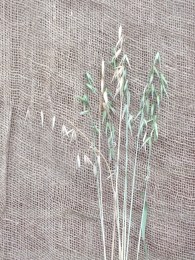
Above: Caffrey’s Oats. Photo provided by Penedesenca
Lettuce (Lactuca sativa)
Bath Cos
Relic Loose Leaf Lettuce This is a commercial lettuce that piqued my interest because I love red lettuces. In the heat of early summer this year the red was so intense that you might have almost called it black. An early lettuce, quite large and it stood a few weeks before flowering. Very pretty contrast in the salad bowl to the usual green lettuces. I now have self seeded second lettuces and will see if it gets through winter. My source was T and M, who no longer sell it. They write: “Lettuce ‘Relic’ is a breeding development from the heirloom ‘Deer’s Tongue’ lettuce to give improved uniformity and good mildew resistance. Its distinctive loose leaf habit and reddish maroon, narrow pointed leaves make an attractive, eye-catching variety with a pleasant taste and texture. Lettuce ‘Relic’ is ideal for successional sowings, standing in good condition without bolting during even hot weather. Height: 25cm (10″). Spread: 30cm (12″).” Galina
https://www.thompson-morgan.com/p/lettuce-relic-looseleaf/gwr4957TM
Other
Polish Amaranth
Sea Kale. Originally from Suttons. Soak seeds overnight before sowing. Once sown plonk them somewhere out of the way germination can be long and erratic. After a couple of years you can force the plants, the harvest and eat the shoots. (I am still yet to do the forcing part) Penedesenca
Pepper, Chilli (Capsicum)
Ohnivec A very large and very hot chilli if left to ripen to red. Nice used when green as they either lack heat or have a kick that doesn’t hang around. These were the only variety grown in the greenhouse but were not bagged. Seeds were originally from Realseeds. Penedesenca
Urfa peper Is a turkish pepper famous for its dried form but also very nice fresh,looks like a sweet peper,tastes like a sweet peper with a little heat. Ruud
Radish
Munchen Bier. This variety of radish is grown for its seed pods rather than it’s root. A great alternative if you struggle to grow decent radish. The pods can be used green in salads and stir fries and gives that distinctive peppery radish taste. They are also great to graze on when in the veg. patch. Penedesenca
Tomato (Lycopersicon lycopersicum)
Bison A determinate(dwarf) red tomato. Ruud
Black Plum Determinate Tomato I received this variety from a very active seedsaver, Ulrike Paradine, in one of my first ever seed swaps, but unfortunately lost contact with her since.
As the name suggests, this tomato is plum shaped and chocolate brown. Of Russian origin and very sweet. I had them outside and in the greenhouse and the garden plants did so much better this year, but it was an outstanding summer with a lot of sun and no blight. They certainly need staking as the multiple stems grow up to 5ft and have a lot of fruit on them. They kept going right until our first frost and we are still eating the last ones that were taken in green.
Can be used for sauces as there are few seeds and the fruits are very fleshy, but all of ours were eaten as salad toms. Here is a cut open fruit and there is also a video on Black Plum and I agree with everything he says: https://www.youtube.com/watch?v=zdWcHIfd7eY Galina
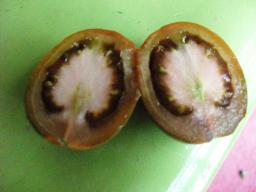
Above: Black Plum Tomato by Galina
Gelbe Königin Tomato When I first got these seeds from an online swap, I used google to translate and it said Golden Queen. However I grew a golden queen tom from HSL and it was a very different tom (very early and lacking flavour). However, this one I would say is a mid season tom a very nice flavoursome salad type tom. (On the sweeter side). Thankfully the original person that sent the seeds was able to enlighten me. She says
“Koenigin” does mean queen. “Gelbe” means yellow, and “Golden” means golden. There actually are two different varieties, a Golden Queen which is commercially available, and this Yellow Queen which is an heirloom variety and not in the shops. I got it about 15 or 20 years ago from a friend who had in turn got it from a school project dedicated to saving old varieties.
The Yellow Queen (Gelbe Koenigin) has been a favourite of mine ever since. It hasn’t disappointed me once, I always get a nice yield, and like you say not too late in summer. I find it is important NOT to wait until the fruit turns golden, as by then it is really over-ripe. It also doesn’t store too well and shouldn’t sit in the kitchen for more than a couple of days. But if picked yellow and eaten fresh it is one of the nicest salad tomatoes.” Penedesenca
Harbinger Indeterminate Tomato An English heritage variety which first appeared in 1891 according to Thomas Etty’s Plant timeline. A classic salad tomato that is round and red, early and productive. Galina
https://www.kingsseeds.com/Products/Vegetables/Tomato/Tomato-Harbinger
Kumato Tomato Indeterminate A salad sized chocolate brown tomato. Said to be hybrid, but I have found no evidence of that. They keep well and can be eaten a little underripe. They do not go over as quickly as other tomatoes. I have grown them both outside and in the greenhouse. More here: https://en.wikipedia.org/wiki/Kumato https://cikipedia.com/10-things-didnt-know-kumato Galina
Tubers
Chinese Artichoke aka Crosnes. These are smallish, white crispy roots of stachys affinis, a member of the mint family and the leaves of the plants look like mint. They are of a consistency akin to radish in salads, but without the heat. They are ready to harvest in late autumn, but they can be left until needed, especially with a mulch. The ones for the circle have started to green up at their growing tips and would appreciate being planted up fairly soon, then set out into the plot after frost. If there is any doubt which end is which, plant sideways and barely cover with soil.
People say they can be difficult to clean. What I do is to place them into a salad spinner with some water, leave to soak, then spin gently. This process removes practically all soil. Usually recommended method of cleaning is with a toothbrush, but soaking in water to loosen the dirt and swooshing around is quicker, maybe just finishing off with the toothbrush if necessary.
They may not be the most exciting salad vegetables, but are available during winter and early spring which is a bonus. They look very exotic and classy served on a bed of lettuce with prawns and seafood sauce. They can also be boiled briefly or stir fried. https://honest-food.net/crosnes-recipe/ Galina
Fuseau Jerusalem Artichoke A true no fuss vegetable, shove it in the ground, forget it and leave it be till after a frost then dig and eat. Nicknamed fartichoke, as can cause flatulence, cooking with herbs such as winter savoury can help. Regardless this deserves a spot in the veg patch. Care should be taken when digging as new plants will grow readily so can spread. Mine have been in the same spot 6 years and haven’t spread. If in a sunny spot they will produce sunflower like flowers in summer. Plants tend to reach 6ft tall. Fuseau is quite a prolific variety. Penedesenca
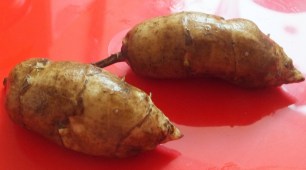
Above: Photo of two small Fuseau tubers by Penedesenca
Potatoes bred by Jayb:
She deliberately crossed the blight susceptible varieties Pink Fir Apple and Ratte with the very blight resistant Sarpo Kifli and the tubers in the packet are the ones that did best for me.
Kifli x Ratte #1 (which I named “Rafli” as Jayb did not name them) has very many tubers, mostly egg sized or a little smaller, a really good flavoured salad spud. Second early with pretty good blight resistance, but not immune to blight.
Kifli x Pink Fir Apple #6 is an absolute “Superspud”. Large tubers (the ones in the circle are smaller seed potatoes), high yield, excellent flavour and waxy consistency. Here they were entirely unaffected when everything else showed signs of blight. The foliage is quite large and they are late. They need maincrop spacing. I have seen flowers on them, but unfortunately none made berries for me so far.

Above: Potato Superspud Photo by Galina
Red Boston Jerusalem Artichoke Same as Fuseau in growth habit. However not quite as prolific so some tubers are best replanted to continue the variety. A red round tuber, though I have never notice a difference in taste from Fuseau. I got this from a lady who had been growing it since the 1970’s. Penedesenca
 Above: Photo of Red Boston Artichoke Tubers by Penedesenca
Yacon – This is red yacon and it has done very well for me. The tall plants produce two kinds of tubers, the large storage tubers, which look very similar to sweet potato tubers and the “crown”, these are not really tubers but nobbly top grows from the stem, which are used to propagate new plants. The tubers in the pack need to be replanted into barely moist compost soon after arrival and the “eyes” should sprout soon into new plants that can be planted out after the last frost.
Yacon grows to about 5ft tall and has small sunflower type flowers very late in the year. I think two varieties are needed to get viable seed, however usually frost gets the flowers before they mature seeds, so seed saving is of academic interest only. They are propagated from crown cuttings. Soon after the first slight frost has affected the leaves, yacon roots are dug. I can never get all of them out without some breakage, but those tubers just get used first, the intact ones store for many months. They look similar to sweet potatoes. The top crown (several nobbly tubers clustered around the stem) is stored dry and frost free until replanted in spring. Or divided and planted up individually in pots for more plants.
Yacon is equally suitable for fruit salad peeled and raw, as it tastes sweet and somewhat like pear, but it can also be sliced and briefly stir fried, when it is similar to water chestnut. I use them both ways. Well known is also yacon syrup which is obtained by boiling and concentrating cut up pieces of yacon. Sweet like maple syrup or honey (and very pricey if bought in the health food shop), but entirely sugar-free and therefore suitable for diabetics. It is recommended to store the tubers for several weeks, for the sweet flavour to develop fully. . More information here: http://www.realseeds.co.uk/unusualtubers.html Galina

Above: The photo shows a couple of the larger tubers next to a pen for size by Galina
Taking part:
1. Penedesenca – Caffrey’s Oats, Sea kale, Gelbe Königin Tomato, Munchen Bier Radish, Ohnivec Chilli, Brown Turkey Fig, Taunton Deane Kale, Red Boston Artichoke, Fuseau Artichoke and Elepant Garlic.
2. Earlypea – DFB Ice Crystal Wax, Japanese Wineberry, Polish Amaranth and Lettuce Bath Cos
3. Galina – CFB George’s, Crochu de Savoie, Lazy Housewife, Tomato Kumato, Babington Leek, Lettuce Relic, Tomato Black Plum, Tomato Harbinger, Potato Rafli and Superspud, Yacon and Chinese Artichoke.
4. Ruud – Urfa peper, black broad bean – black russian, Bison red tomato, purple smaragd tomato, Garden of eden pole bean and Cyrus gray dwarf bean.
5. JanG – Trout bean, Smith River Super Speckle, Hidatsa Shield Figure, Tamila, Buxton Buckshot and Idelight
 Seed Savers Circle